
How to Track AI Visibility for Japanese Websites

In 2025, the emergence of AI Overviews (also known as zero-click search) led to a significant decline in traffic from search engines. This came as a surprise even to us, as a company that continuously monitors SEO performance for websites supporting western companies entering the Japanese market.
One of the most pressing challenges now is how to analyze and respond to traffic coming from AI-driven search going forward. As clients have also begun asking how to measure their visibility in AI search results, we would like to outline one possible approach.
In this article, we use Ahrefs to explain how to measure AI search visibility in Japanese, compare performance with competitors, and analyze the types of websites that four major generative AI search platforms tend to reference when generating answers.
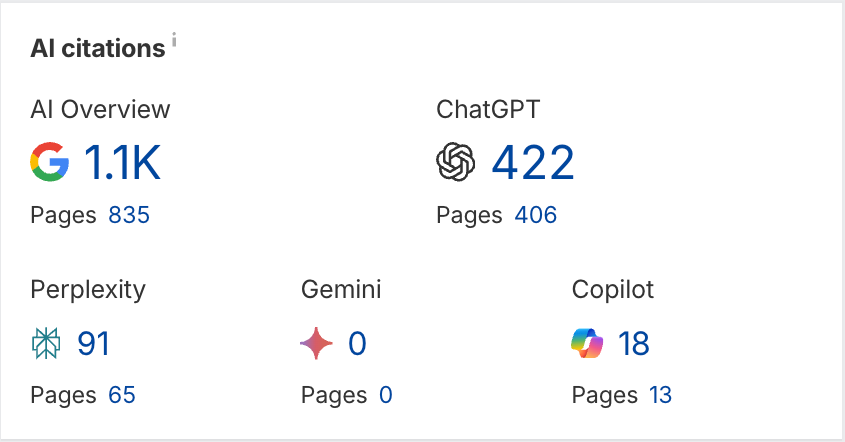
What is the difference between citations and pages?
AI citations count how often this domain was linked in AI results, not including mentions without url.
Pages shows how many unique URLs from this domain were linked.
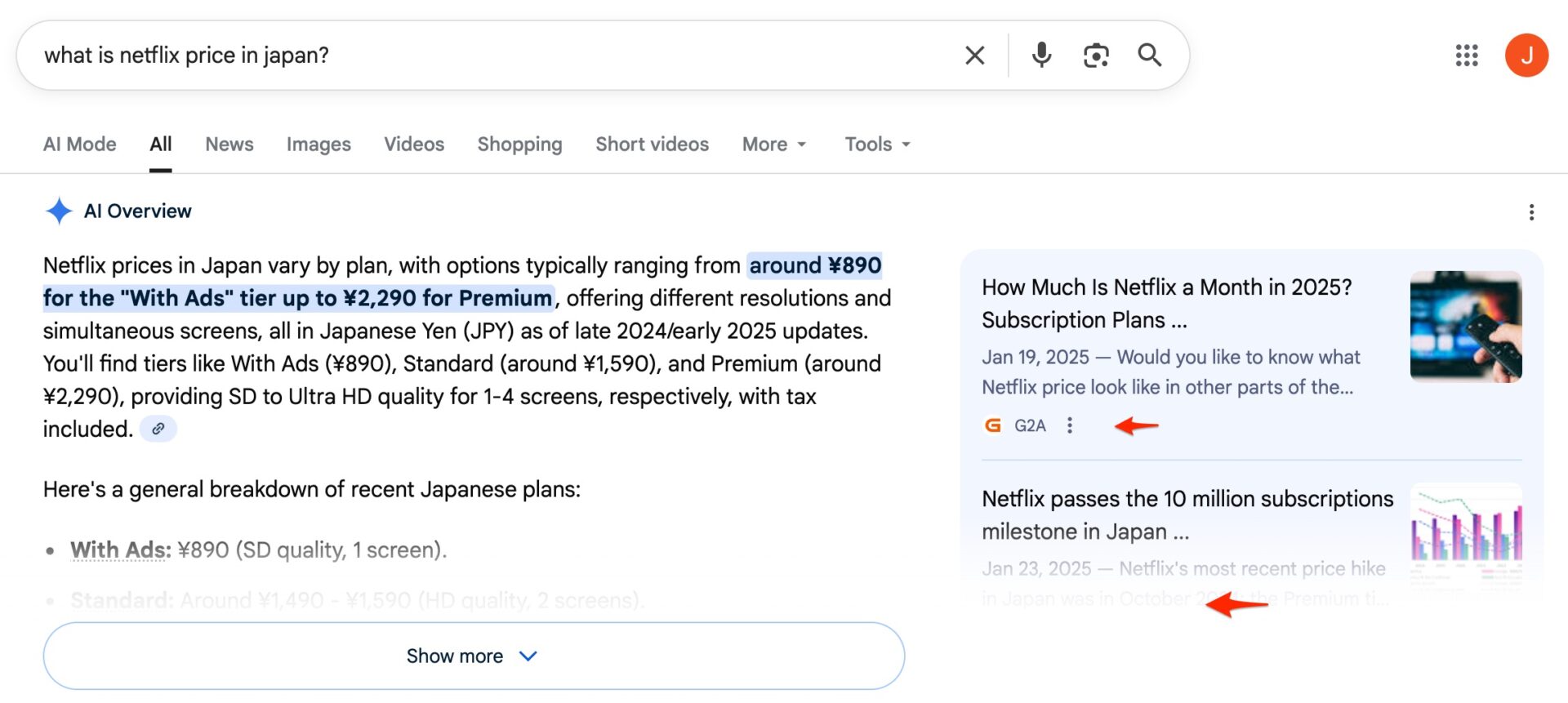
AIOverview search results with url
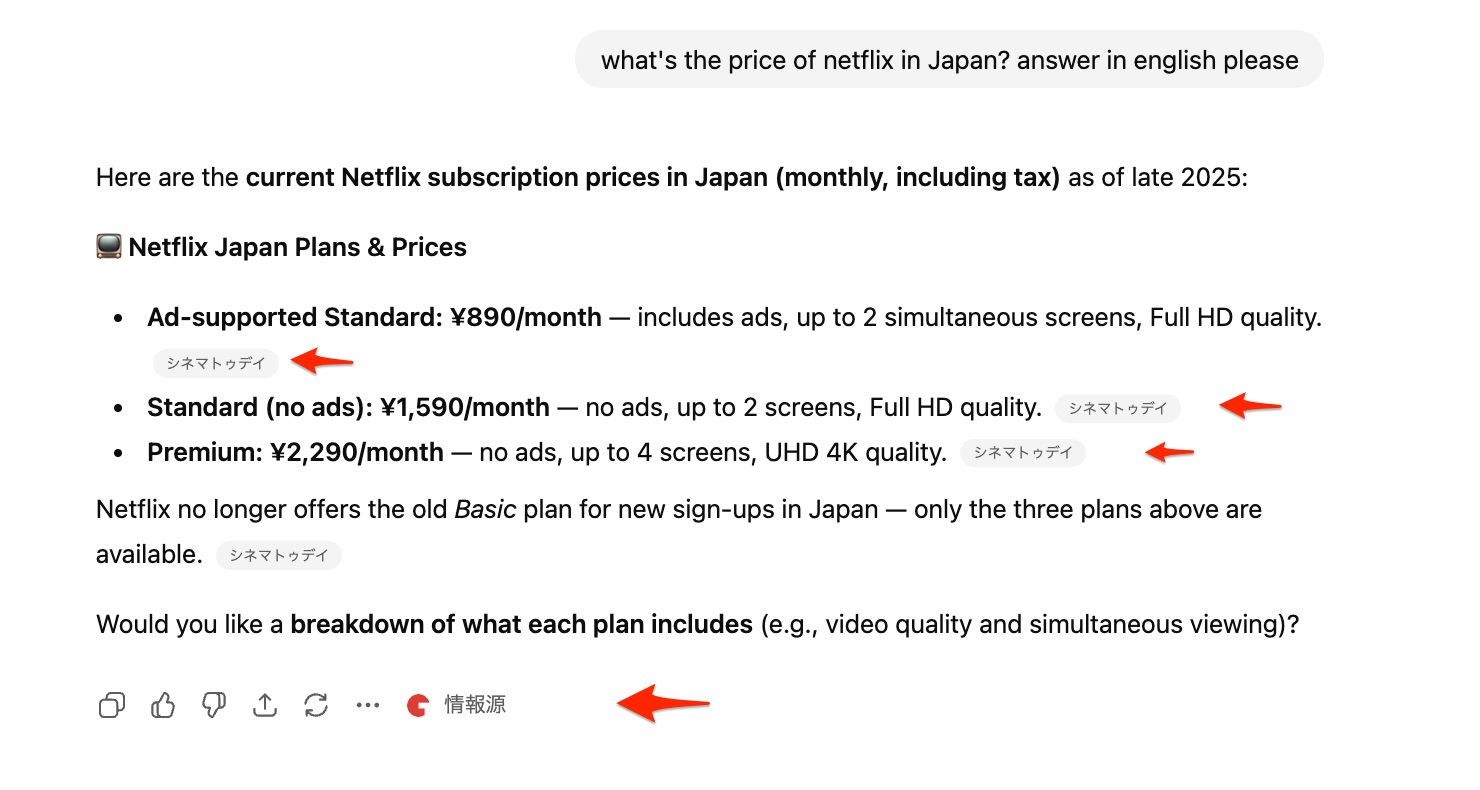
ChatGPT responses with url
In order to measure AI visibility, it is possible to assess a company’s online presence by continuously tracking the number of citations generated by various generative AI searches.
AI Visibility Comparison(Netflix vs U-NEXT vs Hulu vs Amazon prime)
Before moving forward, let me explain the difference between “Mentions” and “Citations.” Mentions refer to occurrences without URLs, while Citations include URLs. I use “Mentions” here because this reflects what users actually see.
Let’s compare the major video streaming service brands in the Japanese market.
Netflix, Hulu, and Amazon Prime are well established in Japan, but unlike in the United States, Japan also has a domestic service called U-NEXT.
Comparison of Mentions for Netflix, U-NEXT, Hulu, and Amazon Prime

In the “All Platforms” column on the right side of the brand list, Netflix ranked first, followed by U-NEXT in second place, Hulu in third, and Amazon Prime in fourth. This comparison chart clearly highlights the AI presence of the major brands and can be effectively used for high level report.
What stands out here is that each brand performs differently across non-Google generative AI search engines.
For example, on ChatGPT, Amazon Prime (844 mentions) ranks second, surpassing U-NEXT (733 mentions). On both Perplexity and Copilot, Amazon Prime overtakes Hulu and ranks third.
Since AI Overview, AI Mode, and Gemini are all Google products, it is not surprising that their algorithms work similarly. However, ChatGPT and other non-Google AI engines operate on entirely different logic. As a result, focusing only on traditional website traffic analysis is no longer sufficient; it is also necessary to observe how brands are being referenced and discussed outside of websites in order to correctly understand emerging trends.
In the next chapter, we will explore patterns in the sources cited by each AI search engine.
Top 25 Most Cited Domains in AI Overview
Let’s return to a marketing perspective and ask ourselves how we can get mentioned. To analyze the sources of mentions, we will look at “citations.”
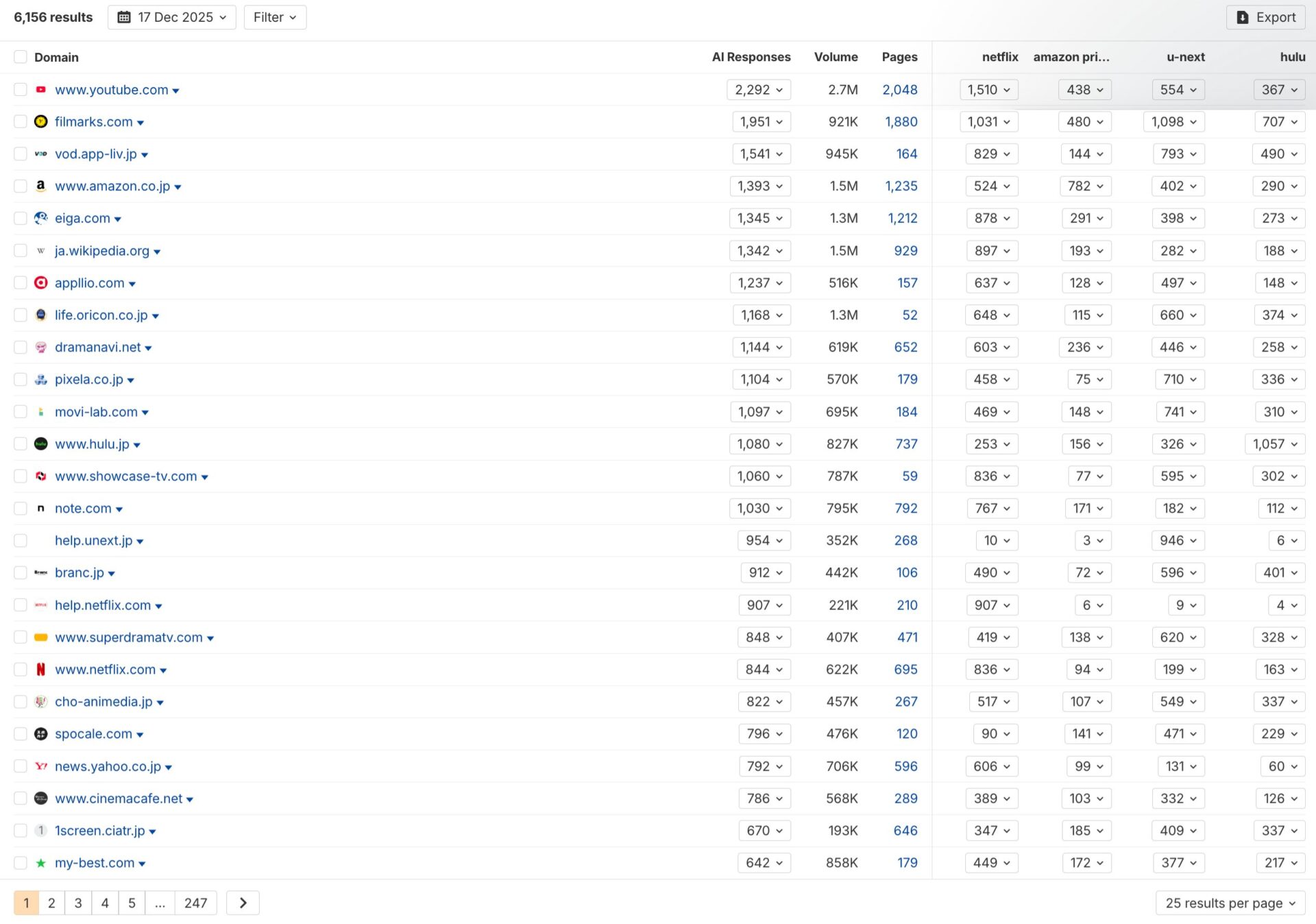
Below is a list of the top 25 domains most frequently cited as information sources for the four video streaming services discussed earlier, ranked by number of responses.
The top-ranked source is YouTube, which is part of the Google ecosystem. This is followed by Filmarks, a review site for movies, TV dramas, and anime, in second place, and Appliv, a review site for video streaming services, in third.
Notably, the sources referenced are not limited to industry-specific media. They also include Wikipedia, Note – a publishing platform similar to Substack – and MyBest, a comparison site. This broad range of cited sources reflects key characteristics of Google’s algorithm.。
Top 25 Most Cited Domains in ChatGPT
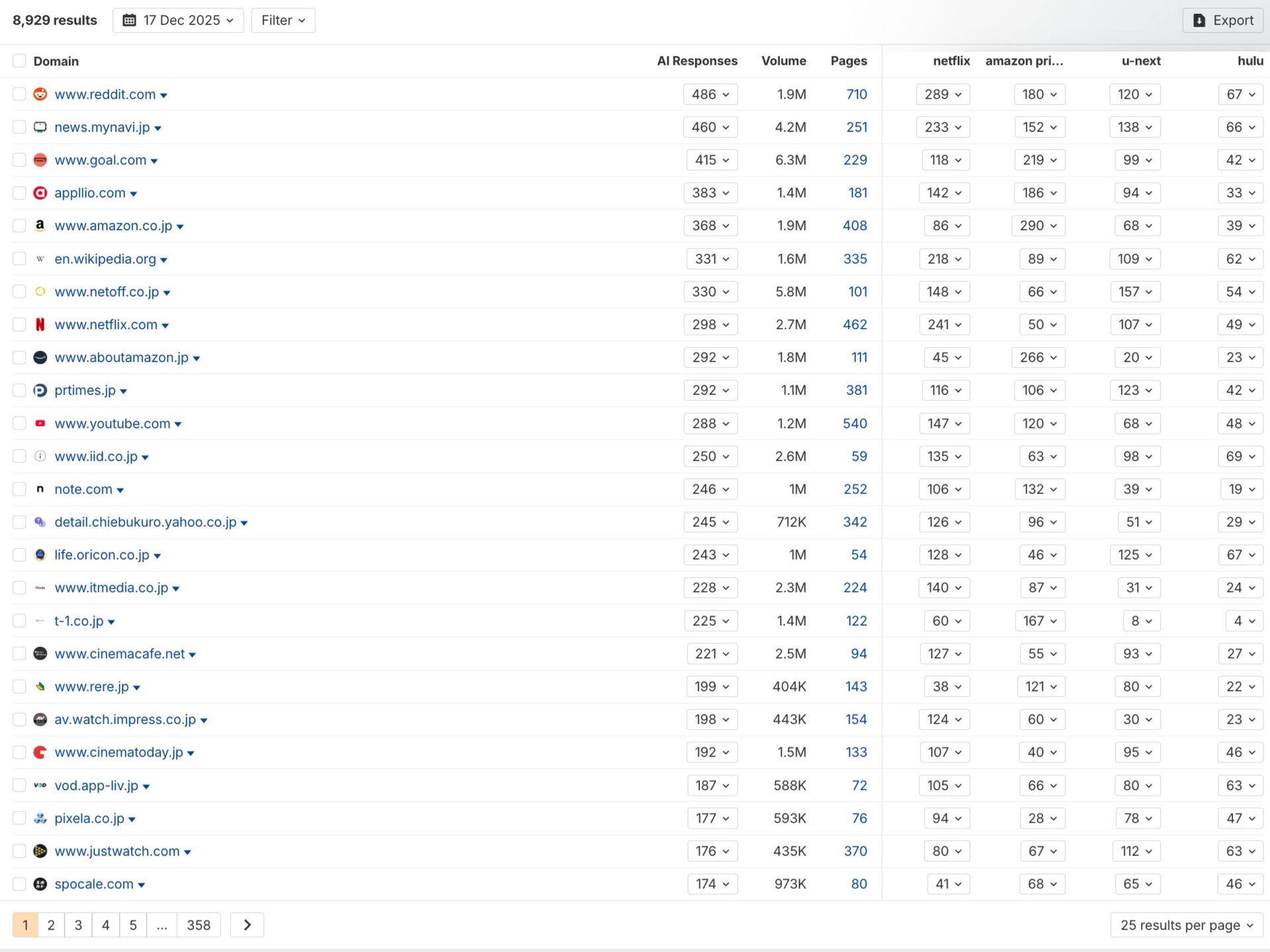
Reddit ranked first, which can be seen as indicative of ChatGPT’s algorithm. In Japan, Yahoo! Chiebukuro often considered a local equivalent of Reddit ranked 14th, but did not make it into AI Overview’s Top 25. Instead, PR Times, a Japan-based press release distribution service, ranked 10th. While the frequent referencing of English-language Wikipedia suggests that information is being sourced across language barriers, it also indicates that ChatGPT has not yet fully grasped the intent to collect information specifically from Japanese-language sources.
Top 25 Most Cited Domains in Perplexity
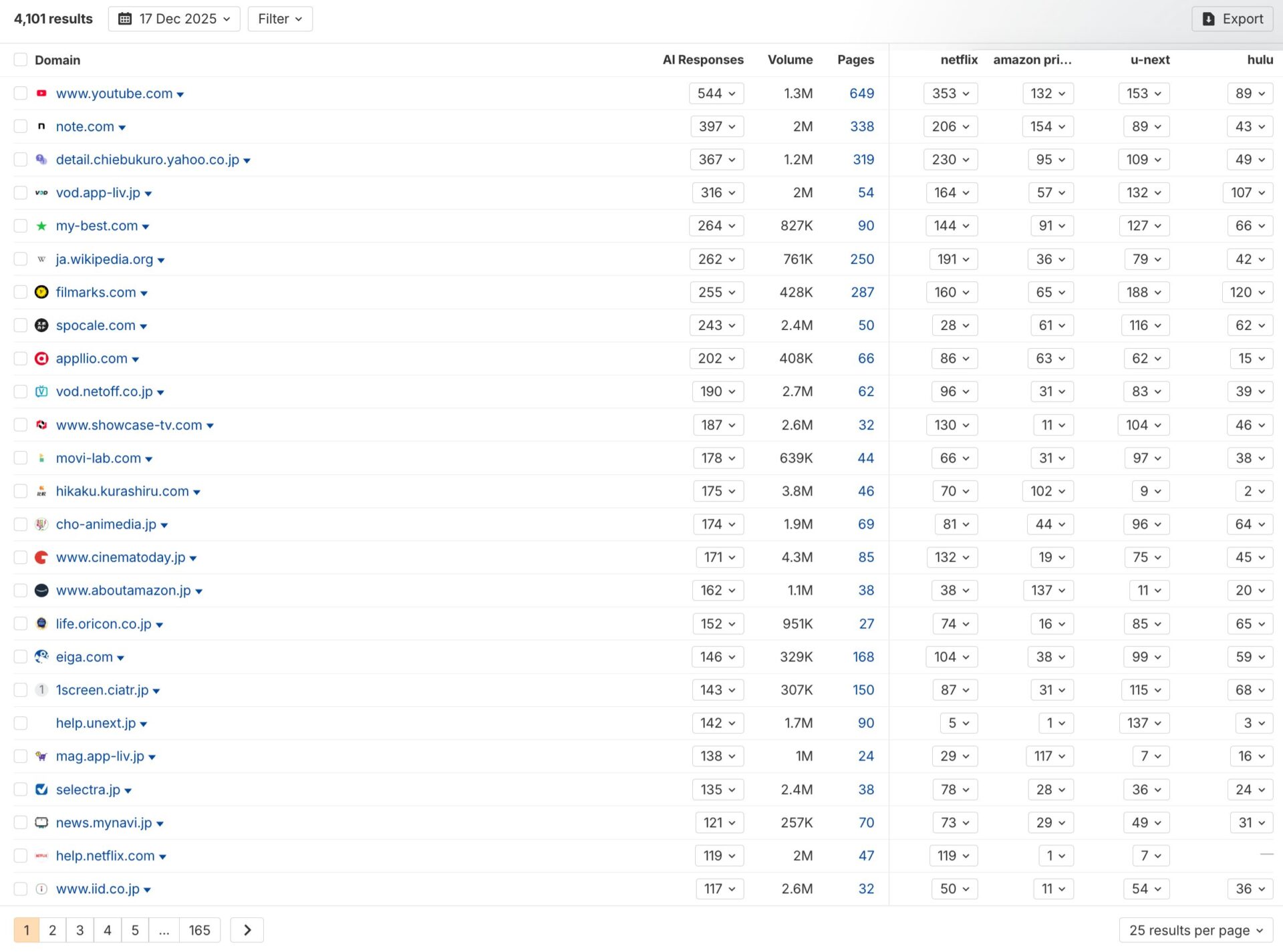
Looking at Perplexity AI’s Top 25, one notable difference is that the official websites that ranked as cited domains in AI Overview and ChatGPT—such as Netflix and Amazon do not appear in the Top 25. Instead, YouTube ranks first, note ranks second, and Yahoo! Chiebukuro ranks third. The prominence of Japanese-language sites suggests that Perplexity AI tailors its citations to local audiences with language as a key factor.
Top 25 Most Cited Domains in Copilot
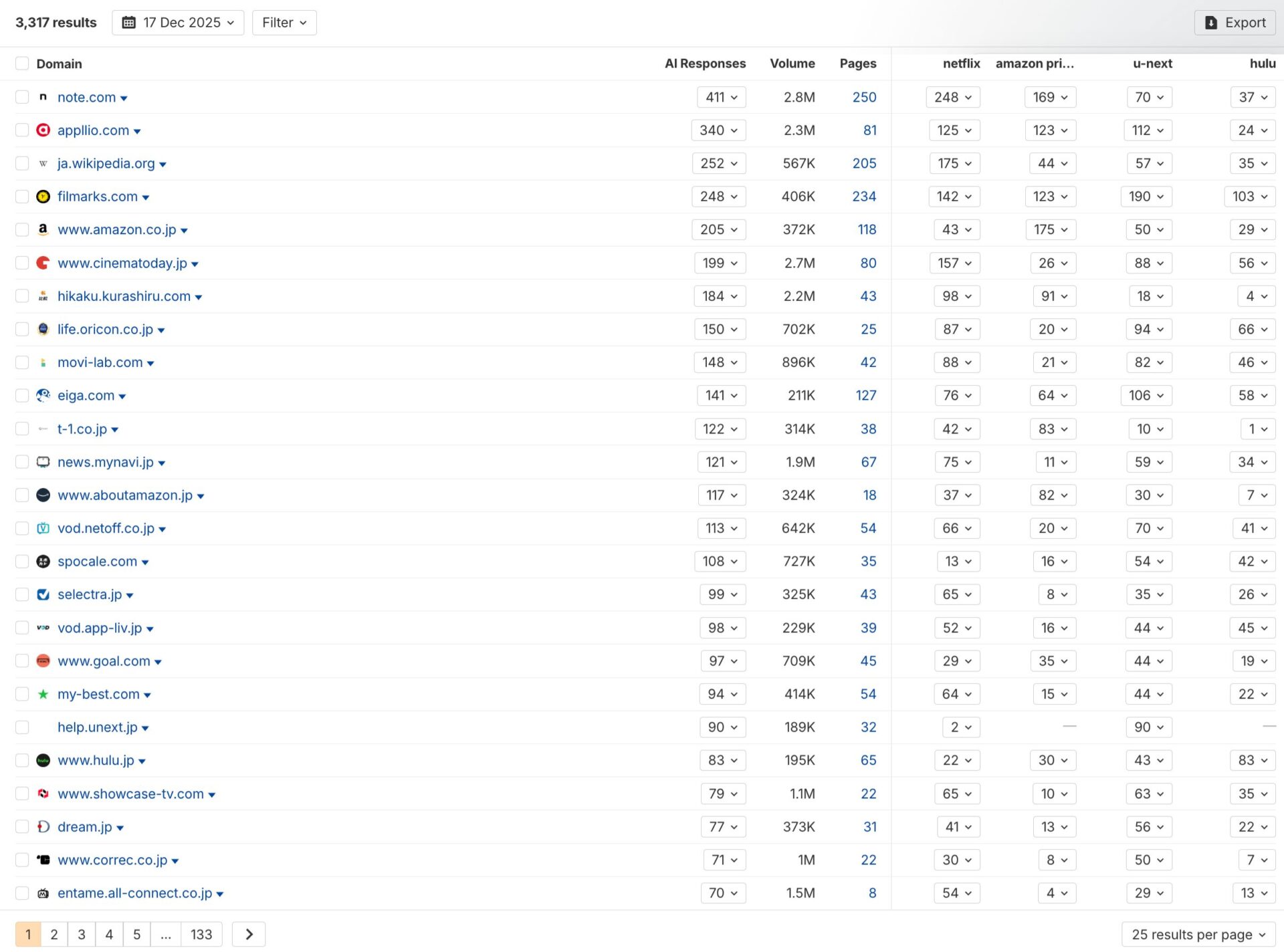
The Top 25 sources cited in responses generated by Microsoft Copilot closely resemble Perplexity’s list of referenced domains, with 18 of the 25 overlapping. Notably, YouTube does not appear among Copilot’s cited sources, which feels almost like a point of pride for Microsoft—a company that has long competed with Google as a search engine rival. For companies marketing to enterprise customers in Japan, one potential approach is to increase visibility within the domains most frequently cited by Copilot, taking into account Microsoft’s strong share in the Japanese corporate market.
Conclusion
In this article, we used Netflix as a case study and simulated AI search–driven traffic using the tool Ahrefs. By comparing Netflix with its competitors, we found that the effectiveness of AI search can vary by brand. While this analysis focused on well-known B2C services in Japan, the results would likely differ in a B2B context. In practice, it is also possible to trace citations beyond the domain level down to individual pages, suggesting that a deeper, more granular analysis is required to succeed in the Japanese market.